UrbanSentinel logoUrbanSentinel

Clean water from sunlight and salvaged electronics.

UrbanSentinel is a solar-powered device built from electronic waste. It tests polluted water in seconds, treats it with chemical-free plasma, and stops the moment the water meets the standard. It is being prepared for the textile rivers around Dhaka and for coastal villages across Bangladesh.

  • Outstanding Award, World Water Challenge 2026, Korea International Water Week
  • Stockholm Junior Water Prize Bangladesh, national winner in 2024 and 2025 for the two projects UrbanSentinel joins
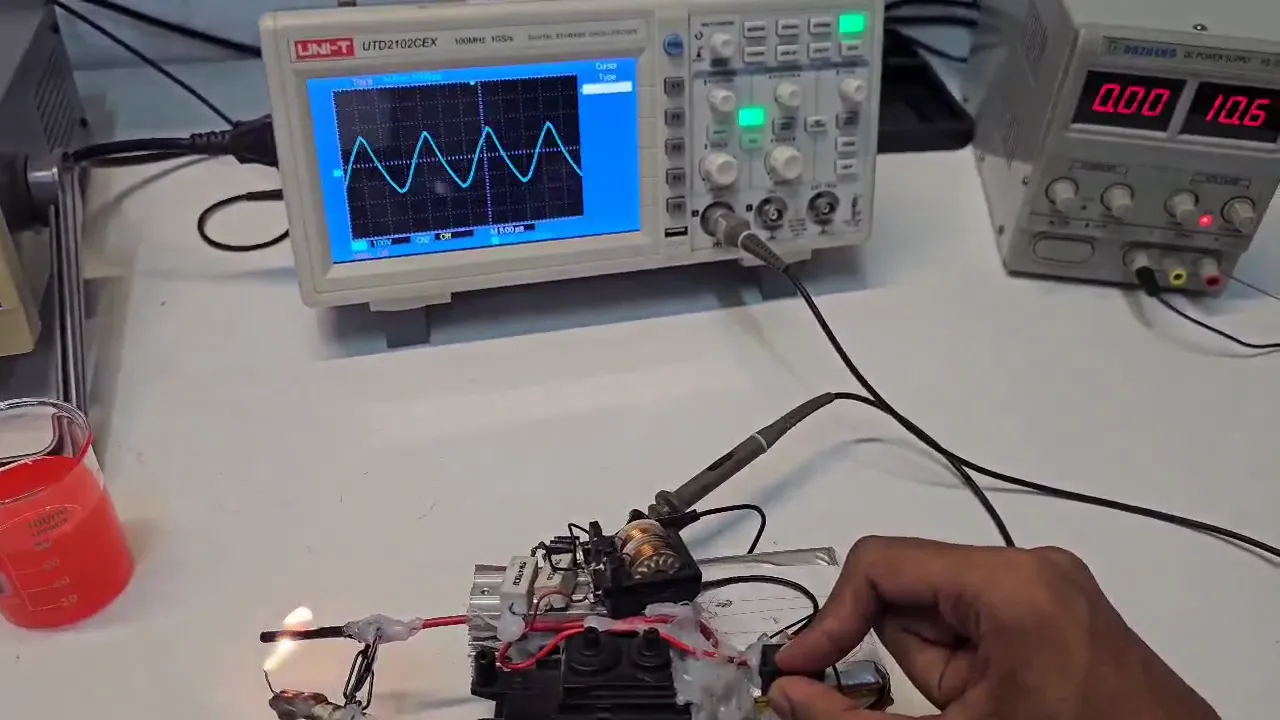
Lab footage
Testing the treatment stage. The oscilloscope traces the driver's switching waveform while the discharge forms at the electrode.

Where the energy comes from

Every watt starts as sunlight. Four of the six stages reuse parts that other people threw away.

  1. Sunlight

    Solar panel

    Charges the battery by day. No grid connection, so floods and outages do not stop it.

  2. Recovered cells

    12–18 V

    A pack of end-of-life laptop and phone lithium cells.

    Salvaged
  3. Switching driver

    About 45 kHz

    MOSFETs from scrapped auto-rickshaw controllers, switching softly at resonance.

    Salvaged
  4. Flyback transformer

    10–12 kV

    Recovered from a discarded CRT television.

    Salvaged
  5. Cold plasma

    55 W peak

    Carbon electrodes from spent dry cells. The water warms by only 2.9 °C in 30 minutes.

    Salvaged
  6. Treated water

    Chemical-free

    Radicals, ozone and UV light are made in the water itself, then the device stops.

Bangladesh's biggest export is washed in Dhaka's rivers

Clothing earns about 81% of Bangladesh's export income. Around Dhaka, 719 factories that wash, dye and finish textiles discharge their wastewater into the rivers, and industry causes about 60% of the pollution in the Dhaka watershed, according to the World Bank.

Every dyeing factory is required to treat its effluent, yet researchers have documented low willingness to comply and weak monitoring and enforcement. The same rivers supply the city: pollution may soon make the Shitalakshya unusable for the Saidabad treatment plants that serve Dhaka, which is why a new intake is being built on the Meghna, about 30 km away.

Part of the problem is time. Illegal discharges tend to happen at night or in heavy rain, while standard laboratory tests take from a day to five days. By the time a result arrives, the plume has passed the intake.

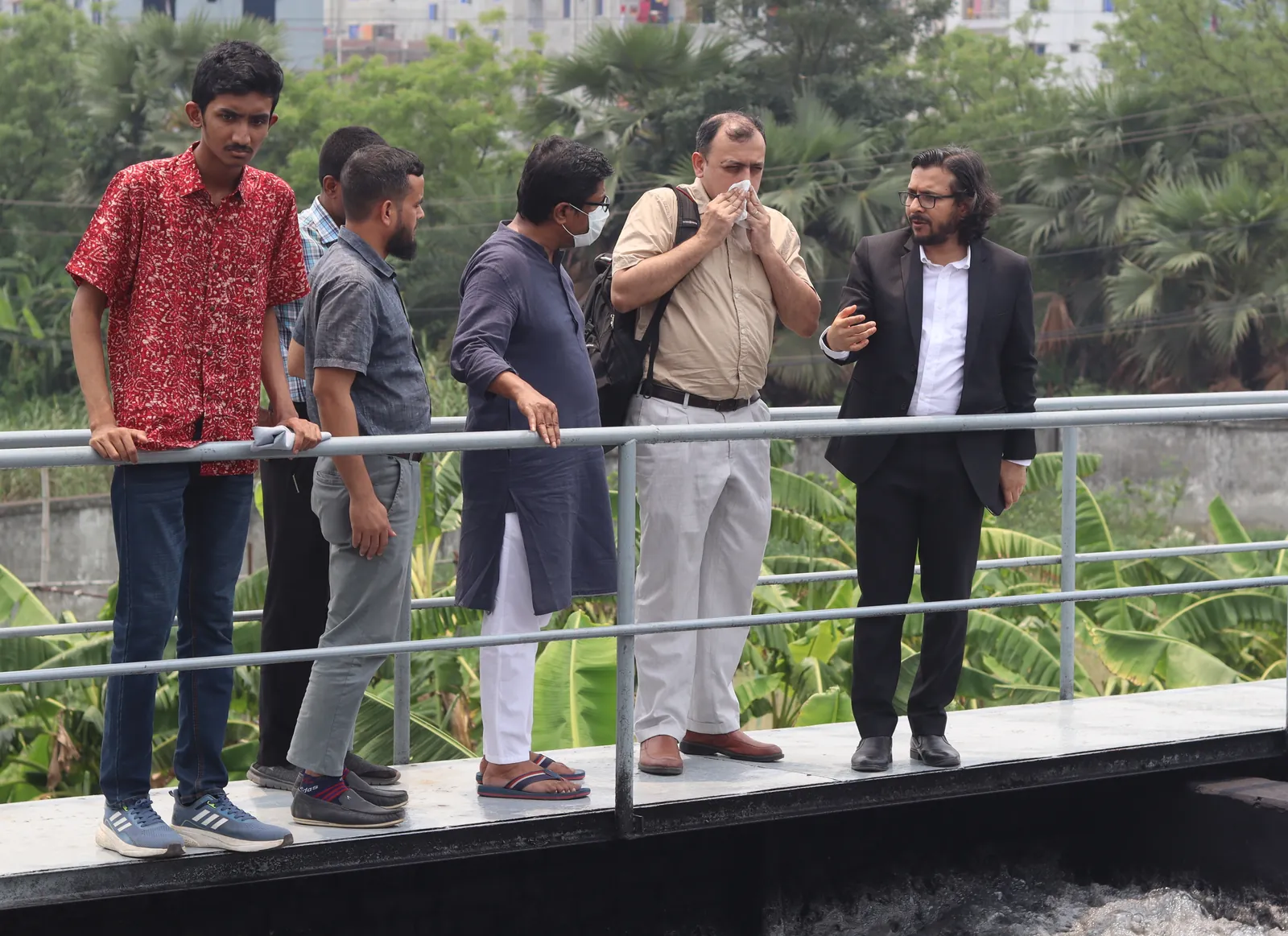
Sampling the Turag river. Collecting a water sample from the Turag river in Dhaka, which receives effluent from the Gazipur–Konabari textile cluster. The Phase 1 pilot places 20 monitoring units on this river.
Effluent aeration basin, BEXIMCO industrial park. Foaming effluent in the aeration basin of the BEXIMCO industrial park. Textile wastewater like this carries dyes, organic load and bacteria, and is what the plasma stage is designed to polish.

Time until a water-quality result

Log scale. Discharges are episodic, so slow results arrive after the plume has passed.

1 second1 minute1 hour1 day1 month6 monthsTwice-yearly factory wastewater test (ZDHC)up to 6 months between testsFive-day BOD laboratory test5 daysColiform confirmation in a laboratory18 to 24 hoursUrbanSentinel estimateseconds
Show the data as a table
MethodTime until a result
Twice-yearly factory wastewater test (ZDHC)up to 6 months between tests
Five-day BOD laboratory test5 days
Coliform confirmation in a laboratory18 to 24 hours
UrbanSentinel estimateseconds

Sources: Export Promotion Bureau data for 2024–25, reported by The Financial Express; World Bank (2017), Bangladesh textile sector and water pollution; Sakamoto et al. (2019), Sustainability 11(7); AFD, Saidabad 3; ZDHC wastewater testing guidelines.

Test. Treat. Verify. Trace.

UrbanSentinel joins two prize-winning projects, an e-waste plasma purifier (2024) and an AI rapid testing system (2025), into one closed loop. The sensor that finds the contamination also decides when treatment ends.

  1. 1

    Sense the water

    UV–visible and mid-infrared light plus electrical readings. No reagents, no sample transport.

  2. 2

    Identify the contaminant

    A neural network on the device estimates BOD, COD and coliform in seconds, without an internet connection.

  3. 3

    Set the plasma

    The AI picks power and frequency to match: a brief pulse for bacteria, a longer run for textile dye.

  4. 4

    Treat with plasma

    A driver built from e-waste turns 12–18 V of solar power into 10–12 kV. No chemicals are added.

  5. 5

    Verify and stop

    The same sensor re-tests the water. The plasma runs until the water passes, then switches off.

  6. 6

    Record and trace

    Each result is logged with the discharge's optical fingerprint, so a network of units can point towards the source.

The connected version, in which the testing module drives the plasma directly, is built and in testing. The results below come from the earlier configuration, with the module and the reactor working side by side. How each part works

What the prototypes have shown

Each figure says how it was obtained. Some are measured on real samples, some are modelled from those measurements, and one comes from a single test that still needs repeating.

Full evidence, including what has not worked yet
96.4%

agreement with laboratory BOD, COD and coliform results, across 28 paired samples

Measured
226 → 0

total coliform per 100 mL after 2–3 seconds of plasma

Measured
−75%

textile dye colour in 25 minutes, from 468 to 115 Pt-Co, in BEXIMCO effluent

Measured
62–92%

less treatment energy by stopping at compliance instead of dosing every batch for the worst case

Modelled
27 → 2 ng/L

PFOA after plasma, below the US EPA limit of 4 ng/L

Single test
0.6–1.8M m³

of untreated effluent a year kept out of the Turag in the Phase 1 pilot

Modelled
Measuredtested on real samples
Modelledcalculated from measured values
Single testone laboratory test, repeat planned
Builtworking hardware exists
Designeddesigned, not yet tested in the field

Clean energy by design

About 98% of Bangladesh's grid electricity comes from fossil fuels, floods cut the power exactly when water is most contaminated, and most of the country's electronic waste is handled informally. UrbanSentinel is designed around all three.

  • Runs on sunlight

    A solar panel charges a 12–18 V pack of recovered lithium cells. With no grid connection, it keeps working through floods and outages.

  • Built from e-waste

    Transistors from scrapped auto-rickshaw controllers, transformers from CRT televisions, electrodes from spent dry cells. The first purifier cost about US$5 in parts.

  • No chemicals added

    The discharge makes hydroxyl radicals, ozone, hydrogen peroxide and UV light in the water itself. No chlorine, no coagulants, no chemical sludge.

  • Only the energy it needs

    Because it re-tests in seconds, it stops at compliance. Modelled saving against worst-case dosing: 62–92% of treatment energy.

Built for factories and for villages

The same device serves two places that today wait days for answers about their water.

Textile effluent plants

For factories, buyers and regulators

  • A polishing and disinfection stage at the outfall of a factory's effluent treatment plant.
  • Logs every batch, giving a continuous compliance record between the twice-yearly tests that international brands require.
  • Phase 1: 3 units at factory treatment plants and 20 monitoring units on the Turag below the Gazipur–Konabari textile cluster.
Pond Sand Filters and flood response

For coastal and flood-affected communities

  • On the saline coast, ponds filtered through sand are often the only fresh water, yet filtered water has carried 7–10 faecal coliforms per 100 mL.
  • An add-on that tests and disinfects Pond Sand Filter water before it is drunk, developed through a WaterAid Bangladesh Youth Fellowship.
  • An earlier portable unit served about 170 families in Feni during the August 2024 floods.

Four versions in three years

Each version was judged by an independent jury before the next one was built.

The full story
  1. 2023

    First high-voltage experiments

    Desk-top plasma tests built from salvaged parts.

  2. 2024

    Plasma purifier from e-waste

    Stockholm Junior Water Prize Bangladesh, national winner.

  3. 2025

    AI rapid water testing

    Stockholm Junior Water Prize Bangladesh, national winner again.

  4. 2025

    HydroPlasmaX

    Bronze medal, Genius Olympiad, New York. The first combination of the two.

  5. 2026

    UrbanSentinel

    Outstanding Award, World Water Challenge, Korea International Water Week.

In the news

35 articles and features from outlets in 9 countries, from The Daily Star and UNICEF to Antena 3 CNN in Romania.

All coverage